
Storbåtsegga (project title “Hydra”) is a semi-closed production tank with a capacity of 3,120 tonnes of salmon. The unit has a sealed roof and walls extending down to 20 meters below the sea surface. The enclosed structure is designed to prevent lice and disease-causing microorganisms, which generally move in the upper layers of the ocean, from entering the tank. The Ocean Tank is also engineered to prevent fish escapes, as all materials in the construction are significantly stronger than those used in today’s open-net fish farming pens.
Through a manually controlled water exchange system, adapted to the strong ocean currents at the site, continuous access to fresh, oxygen-rich seawater is ensured. At the same time, the open-bottom design allows fish waste to be naturally dispersed by the current.
The result is a robust and innovative solution that promotes good fish welfare, with reduced risk of lice, disease, and escapes. This is an important step toward a more sustainable and forward-looking aquaculture industry.
KEY FIGURES:
| Height | Approx. 50 meters from bottom to top |
| External diameter | 78 meters |
| Internal diameter | 60 meters |
| Production volume | 86 700 cubic meters |
| Maximum allowed biomass | 3120 tonnes |
| Operational draft (hull) | 30,6 meters |
| Operational draft (including net) | 49,4 meters |
| Maintenance draft | 11,5 meters |
| Feed storage | 200 tonnes |
| Energy sources | Shore power, backup diesel generator, emergency generator |
| Weight | 6000 tonnes (15.000 tonnes with ballast water) |
News and updates
Why Nordlaks has chosen this technology
A semi-closed production tank provides a physical barrier against the upper layers of the sea where salmon lice are most prevalent. What makes this concept unique is its system for water exchange and circulation within the structure.
Nordlaks views the technology in this project as an important contribution to the continued development of the company and to the technological diversity of the aquaculture industry. By realizing this project, Nordlaks will build competence in the design and operation of semi-closed systems, with expected benefits in terms of both escape prevention and biosecurity, particularly regarding salmon lice control.
How does The Ocean Tank work?
The Ocean Tank consists of a sealed, cylindrical structure submerged in the sea, with a floating ring at the top and a closed roof. The tank is watertight down to about 20 meters, protecting the fish from salmon lice and diseases that move in the surface water. Below this, from 20 to 27 meters, the tank is open to the sea (closed only with a metal mesh).
At the bottom of the structure are fixed guide vanes, angled ribs that direct seawater naturally in and out of the tank. This ensures continuous water exchange and circulation, providing the fish with fresh, oxygen-rich seawater without drawing in surface water.
At the base, oxygen diffusers and compressor hoses are installed to aerate the water during naturally low-oxygen periods, for example during tidal slack when currents stop. Circulation pumps can also be added in strategic positions if needed to secure optimal water flow inside the tank. Organic waste sinks through the open bottom and is naturally dispersed by ocean currents.
Watch the illustration video here:
Sailing route
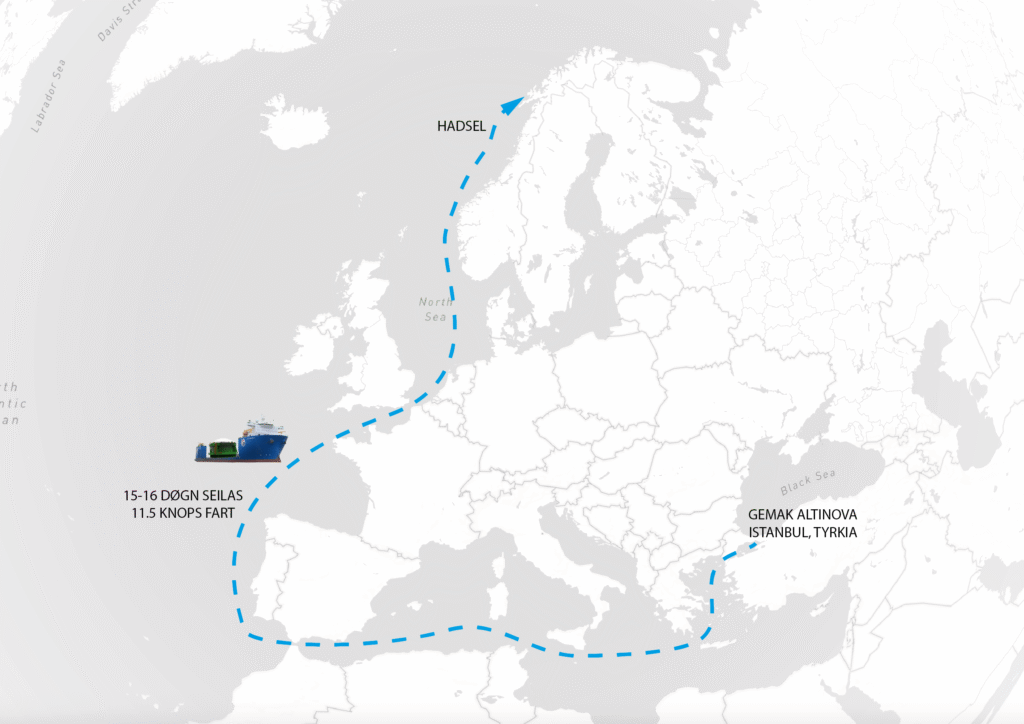
Storbåtsegga is transported on the deck of GPO EMERALD from the GEMAK shipyard in Turkey. The northbound voyage takes between two and three weeks.
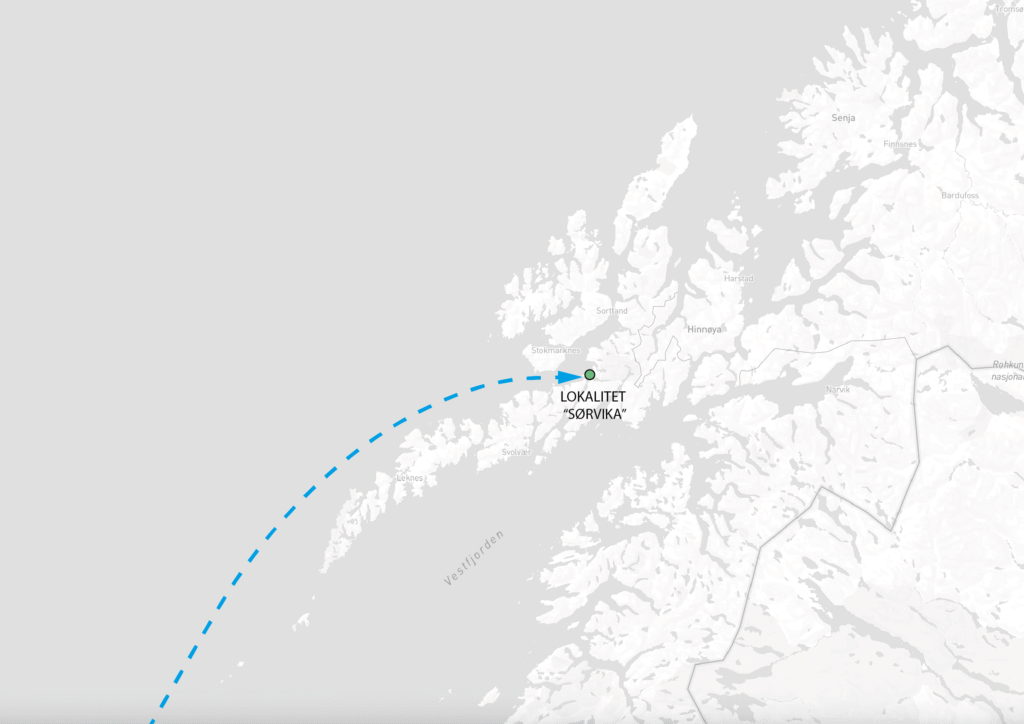
The unit will be unloaded in Ingelsfjorden, in Hadsel Municipality.

Storbåtsegga will be unloaded before being towed to the Sørvika site in Raftsundet, where it will be anchored.
Reports:
Norwegian: Functional Test Report 2026
Questions?
Contact:
Heidi Ryste, head of marketing and communications: heidi.ryste@nordlaks.no
Kolbjørn Hoseth Larssen, communication advisor: kolbjorn.larssen@nordlaks.no